
Why is it So Cold if the Earth is Warming?
This winter, the East Coast of the U.S. has been particularly bone-chilling, with long stretches of well-below freezing temperatures and several heavy snow falls. What gives? Why is it so cold if the Earth is experiencing global warming?
Global warming is global, meaning the sum total of the temperatures across the planet as well as over time. So while we might be freezing our butts off now, remember those stretches of 90 plus degree days in the past. Additionally, this winter has been exceptionally warm in the western U.S., with record warmth and low snow totals. The West relies on melting snowpack in the spring to provide water for agriculture. Without a large snowpack, there will be a water shortage. Looking beyond the USA, Australia, whose summer is our winter, experienced temperatures over 120 degrees Fahrenheit, causing fires and power outages.
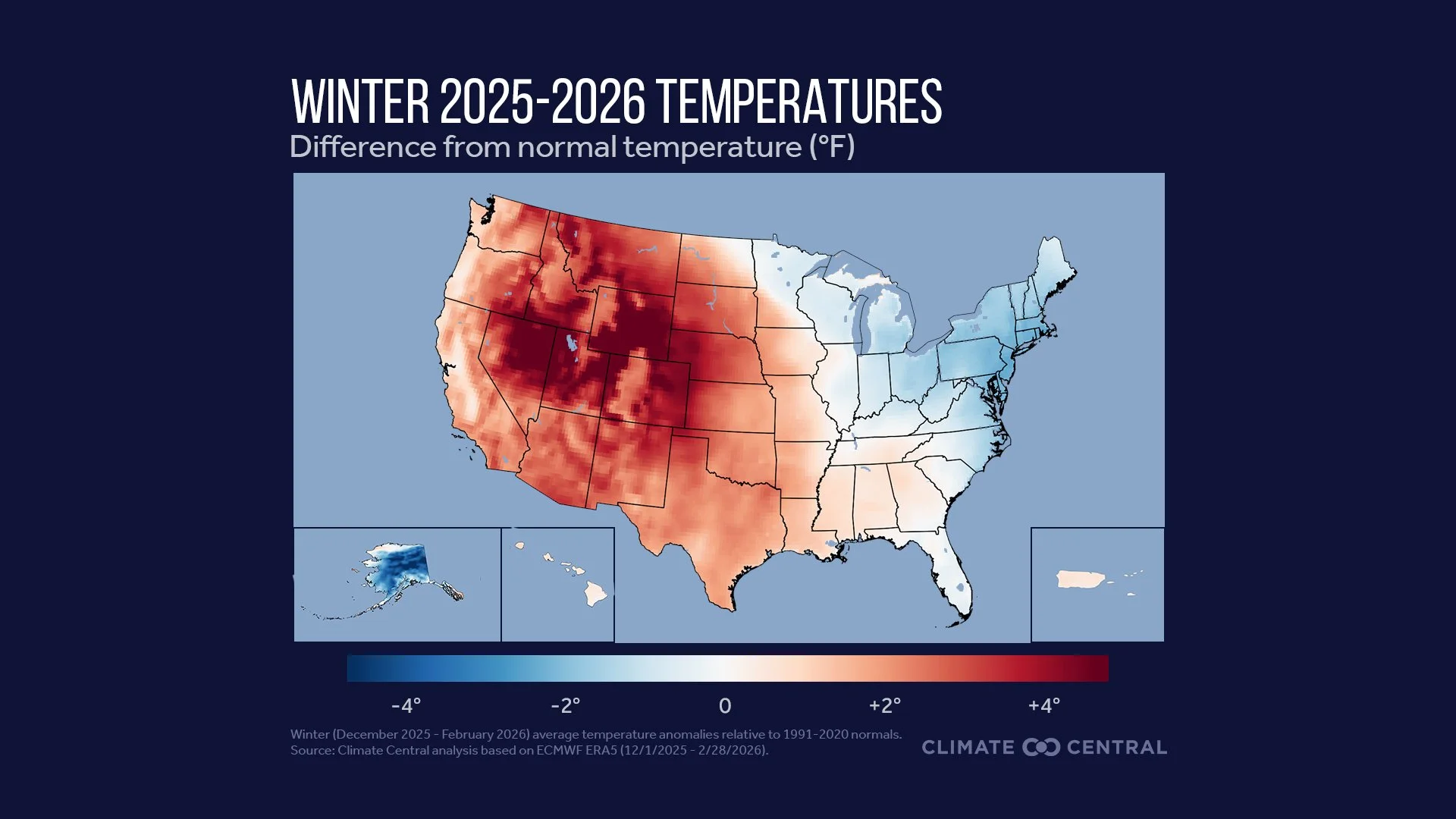
This winter the East Coast was colder than normal, while the West was exceptionally warm, breaking several records. Credit: Climate Central
So now that we’ve looked at the big picture, what specifically has caused such extreme cold here on the East Coast this winter? For that you can blame the impact of climate change on the polar vortex. Normally the polar vortex is a nice circle of cold Arctic air far north of Philadelphia. But when the jet stream weakens, it lets that cold slip down well into the southern US. Many scientists agree that the movement of cold air to the south is caused paradoxically by warmer Arctic air.
The Arctic is warming four times as fast as the rest of the planet. One of the main reasons is the melting of the sea ice. As the ice melts, it exposes warmer water beneath, allowing more heat to escape. The loss of ice also changes the surface from a lighter color (ice) to a darker one (open seawater) which absorbs more heat. This causes a warming spiral: as the Arctic gets warmer, more ice melts, which causes it to get even warmer.
Because the Arctic is warming faster than the rest of the planet, the temperature difference between the polar region and the land to the south decreases. This weakens the jet stream–whose strength depends on that temperature difference– allowing cold Arctic air to move south more often..

On the left you can see what has been typical in the past with a strong jet stream and a stable polar vortex. On the right you can see what happens when the jet stream weakens, letting cold air dip into the southern part of the U.S. Credit: NOAA
This change in temperature patterns across the planet means that our weather isn’t as predictable as it used to be. Some say we should call it Global Weirding instead of Global Warming. The climate crisis is causing more extremes on both ends, extreme cold and extreme warmth, extreme precipitation and extreme drought. We need to do all we can to slow down climate change or these extremes will just get worse.
Resources:
https://www.nytimes.com/2024/12/17/climate/worrying-signs-arctic.html
https://en.wikipedia.org/wiki/2025%E2%80%9326_North_American_winter
https://www.nytimes.com/2026/01/24/climate/climate-change-polar-vortex.html
https://www.climatecentral.org/climate-matters/2025-us-winter-attribution
https://www.theguardian.com/us-news/2026/apr/01/snowmelt-american-west